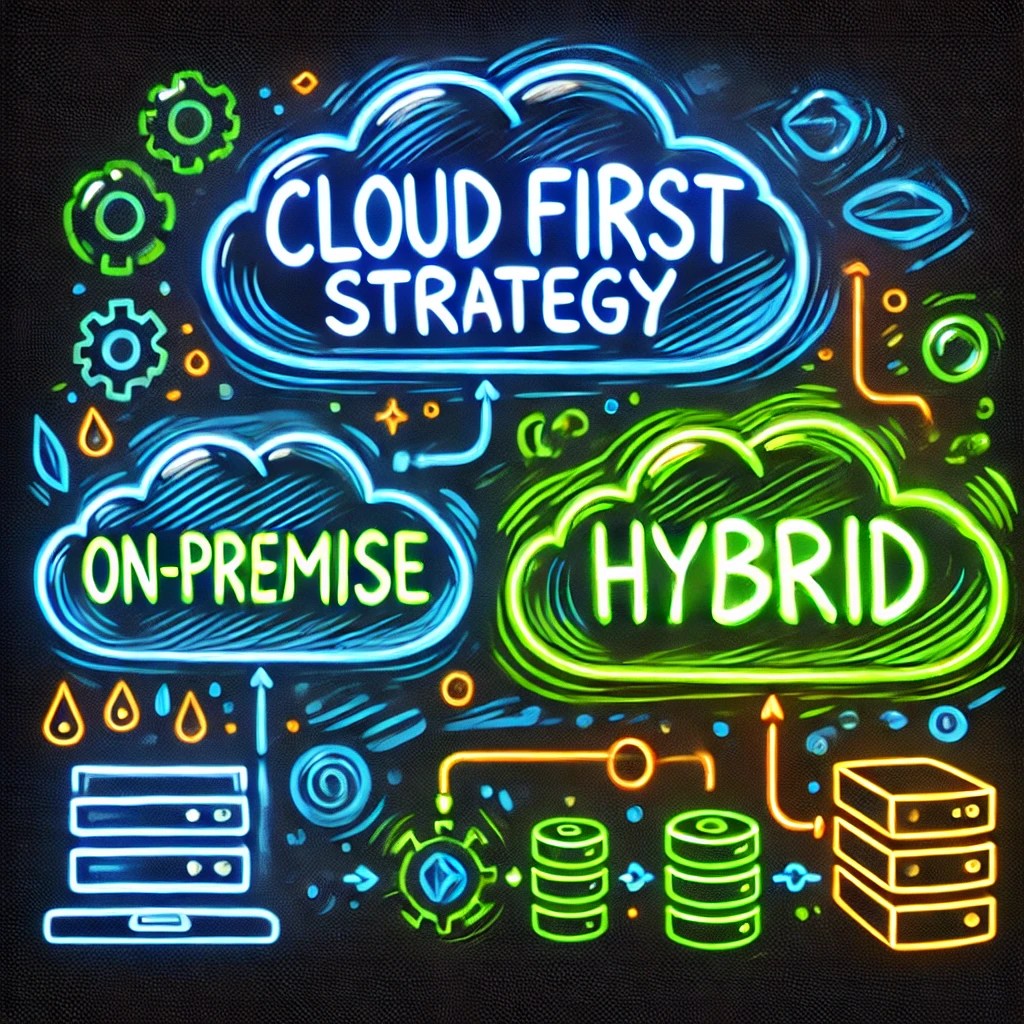
The rapidly evolving digital landscape has businesses at a crossroads, especially when it comes to choosing the right IT infrastructure. With cloud-first strategies gaining momentum, on-premise infrastructure still holding its ground, and hybrid IT infrastructure models offering the best of both worlds, organizations must carefully evaluate which solution aligns with their needs, security requirements, and future growth strategies.
In this article, we’ll explore the benefits, challenges, and real-world case studies of these three main strategies—cloud-first, on-premise, and hybrid—offering insights into compliance requirements, scalability, and the latest trends in cloud computing. Whether you’re a startup looking for flexibility, a large enterprise focused on regulatory compliance, or a business with legacy systems, this comprehensive guide will help you choose the right IT infrastructure.
What is a Cloud-First Strategy?
Understanding the Cloud-First Strategy
A cloud-first strategy prioritizes cloud-based solutions over traditional IT setups. Instead of investing in physical servers and data centers, organizations adopt cloud services like Amazon Web Services (AWS), Google Cloud, and Microsoft Azure. This strategy enables businesses to access scalable, flexible, and cost-efficient infrastructure without the heavy burden of maintaining on-premise hardware.
Benefits of a Cloud-First Strategy
- Cloud scalability and flexibility: Cloud-first environments allow businesses to quickly scale resources up or down based on demand, making it ideal for organizations with fluctuating workloads or seasonal surges.
- Reduced upfront costs: Cloud computing eliminates the need for large capital expenditures on physical hardware. Instead, organizations can pay for what they use, creating cost efficiencies, especially for startups and small businesses with limited budgets.
- Access to the latest cloud computing technologies: Cloud providers frequently update their platforms with cutting-edge features such as AI, machine learning, and advanced analytics. This helps businesses stay at the forefront of innovation.
Challenges of a Cloud-First Strategy
- Potential cloud security concerns: While cloud providers invest heavily in security, businesses may face challenges regarding visibility and control over their data. Cloud services can increase the risk of external breaches.
- Dependence on internet connectivity: Cloud services require stable and consistent internet access. For businesses operating in areas with unreliable connectivity, this can pose significant risks to operations.
- Cloud compliance challenges: Navigating compliance in the cloud can be complex, especially for industries like healthcare and finance that have strict regulations on data residency, privacy, and encryption.
Real-World Application: Cloud-First Case Study
A fast-growing SaaS company that developed a productivity platform adopted a cloud-first strategy to scale rapidly. They leveraged Google Cloud’s global infrastructure to serve customers in multiple regions. By opting for cloud services, they reduced server maintenance costs and integrated Google’s AI tools to enhance their product. This allowed the company to expand internationally within two years while avoiding the high costs of traditional infrastructure.
Ideal For:
- Businesses seeking rapid growth
- Startups needing cost-efficient scalability
- Companies that want to avoid managing physical infrastructure
Exploring On-Premise Infrastructure: Control and Compliance
What is On-Premise Infrastructure?
An on-premise IT infrastructure involves physical servers, hardware, and software located within the organization’s facilities. This traditional model provides businesses with full control over their IT environment but requires significant investment in hardware, IT staff, and ongoing maintenance.
Benefits of On-Premise Infrastructure
- Complete control over data and systems: On-premise infrastructure allows businesses to have direct control over their IT systems and data, which is especially important for industries like defense, finance, and government.
- Tailored hardware and software setups: With on-premise systems, businesses can customize their IT environments to meet specific operational and regulatory needs, including specialized hardware configurations and custom-built applications.
- Simplified compliance with industry regulations: On-premise infrastructure can simplify compliance with strict data privacy and security laws such as HIPAA (Health Insurance Portability and Accountability Act) and GDPR (General Data Protection Regulation).
Challenges of On-Premise Infrastructure
- High upfront costs: The initial capital investment required to purchase, install, and maintain servers, storage devices, and networking equipment can be prohibitive for smaller businesses.
- Ongoing maintenance and upgrades: On-premise systems require constant maintenance and regular upgrades to keep pace with technology advancements, which adds to operational costs.
- Limited scalability compared to cloud environments: Scaling an on-premise infrastructure requires purchasing and installing additional hardware, which can be time-consuming and costly during periods of rapid growth.
Real-World Application: On-Premise Infrastructure Case Study
A large multinational financial institution opted for an on-premise IT infrastructure to meet the stringent security and data residency requirements of different jurisdictions. They built data centers in multiple countries to store sensitive customer data locally, ensuring compliance with both GDPR and regional regulations. This costly but secure solution allowed the institution to manage its operations with greater control and meet strict compliance standards.
Ideal For:
- Enterprises with strict regulatory compliance requirements
- Industries where security and data sovereignty are top priorities
- Businesses with legacy systems that require on-premise control
Hybrid IT Infrastructure: Flexibility Meets Control
What is a Hybrid IT Infrastructure?
A hybrid IT infrastructure combines the best of cloud and on-premise solutions, allowing businesses to retain sensitive data on-premise while leveraging the scalability and cost-efficiencies of cloud computing for less critical or fluctuating workloads.
Benefits of a Hybrid IT Infrastructure
- Flexibility and control: Hybrid models enable businesses to store sensitive or critical data on-premise, where they have full control over security, while using cloud resources for less-sensitive operations such as data analytics, backups, or hosting non-critical applications.
- Disaster recovery and scalability: Cloud services provide excellent backup options for on-premise systems, enhancing disaster recovery capabilities and minimizing downtime during system failures. The cloud’s scalability allows businesses to expand certain operations without overhauling their entire on-premise infrastructure.
- Gradual cloud adoption: For organizations with significant investments in legacy systems, the hybrid approach offers a smooth transition to cloud computing without abandoning existing infrastructure.
Challenges of a Hybrid IT Infrastructure
- Complexity in managing dual environments: Managing both on-premise and cloud-based systems can introduce complexity. Organizations need robust integration and monitoring tools to ensure seamless operation between cloud and on-premise environments.
- Increased security risks: With more access points between cloud and on-premise environments, hybrid systems can be more vulnerable to security breaches. Businesses need to implement strong security protocols to protect both environments.
- Higher operational costs: Maintaining both physical infrastructure and cloud services can lead to higher overall costs, especially when factoring in licensing fees, hardware purchases, and the additional IT personnel needed to manage dual systems.
Real-World Application: Hybrid IT Infrastructure Case Study
A global retail chain adopted a hybrid IT infrastructure to handle sensitive customer data and scalable business operations. They retained their on-premise systems for processing sensitive customer data, like credit card information, to comply with PCI-DSS (Payment Card Industry Data Security Standard) requirements. At the same time, they used AWS to handle their inventory and supply chain management, especially during high-demand periods like Black Friday. This dual system allowed them to maintain control over critical data while leveraging the cloud’s scalability.
Ideal For:
- Organizations transitioning to the cloud
- Businesses needing to maintain legacy systems while taking advantage of cloud scalability
- Enterprises seeking flexibility without sacrificing control over critical operations
Compliance and Regulatory Insights for IT Infrastructure
Industry-Specific Compliance Challenges
When selecting between cloud-first, on-premise, or hybrid infrastructure, businesses need to account for industry-specific regulatory frameworks such as:
- Healthcare: Healthcare organizations must adhere to HIPAA, which mandates stringent controls over patient data privacy. Many opt for hybrid IT infrastructure models to store sensitive patient information on-premise while using cloud-based solutions for non-sensitive operations like patient scheduling.
- Finance: Financial institutions face compliance challenges such as GDPR and Dodd-Frank Act requirements in the US, which dictate how and where sensitive customer data can be stored. Hybrid solutions allow financial companies to keep critical data on-premise while using the cloud for analytics or customer engagement tools.
- Government: Government agencies often need to keep highly sensitive data on-premise to ensure data sovereignty. In countries like the UK, hybrid IT infrastructure is often used, with cloud services handling non-critical operations while sensitive data is kept in secure on-premise systems.
Cost Considerations for IT Infrastructure
- Cloud-First: Lower upfront costs with a pay-as-you-go model but potentially higher long-term operational expenses, depending on usage.
- On-Premise: High initial investment but more predictable long-term costs for stable workloads.
- Hybrid: Offers a balanced approach but introduces additional costs due to managing both on-premise and cloud environments.
Security Implications Across IT Infrastructure Models
- Cloud-First: Shared security responsibilities between the business and cloud provider. Businesses must ensure strong Service Level Agreements (SLAs) and implement their own security protocols.
- On-Premise: Complete control over security, but the full burden falls on the organization to protect its systems.
- Hybrid: Requires careful coordination to secure both cloud and on-premise environments, ensuring that data is protected during its transition between systems.
Scalability and Flexibility: The Power of the Cloud
- Cloud-First: Easily scalable, ideal for businesses with fluctuating demand or growth spurts.
- On-Premise: Scaling requires purchasing and installing additional hardware, which can be time-consuming and expensive.
- Hybrid: Provides the flexibility to scale specific workloads in the cloud while maintaining core operations on-premise.
FAQs on Cloud-First, On-Premise, and Hybrid IT Infrastructure
- What is the difference between cloud-native and cloud-first strategies?
- Cloud-native refers to applications built specifically for cloud environments, while cloud-first prioritizes cloud solutions but still allows for the integration of on-premise systems.
- Can small businesses benefit from on-premise infrastructure?
- While on-premise infrastructure is typically more suited for large enterprises, small businesses with stringent security or compliance requirements can still benefit. However, many opt for hybrid models for cost-efficiency and flexibility.
- How does a hybrid IT infrastructure enhance data security?
- A hybrid infrastructure allows businesses to store sensitive data on-premise, where they have full control, while using cloud services for less critical data. This dual-layer security approach minimizes risk.
- What are the first steps to transitioning to a cloud-first strategy?
- Identify cloud-compatible workloads, choose a cloud provider that meets your security and compliance needs, and migrate non-critical applications first to ensure a smooth transition.
- How do compliance requirements affect IT infrastructure choices?
- Compliance regulations like HIPAA and GDPR dictate whether you can use cloud services or must rely on on-premise systems. Many businesses opt for hybrid solutions to meet compliance while leveraging the cloud’s benefits.
Personal Experience: Managing Hybrid and Cloud-First Strategies in Global IT Projects
- During one of my last work experience, I was directly involved in the digital transformation of a global B2B platform serving customers across industries. This complex project required us to navigate both on-premise legacy systems and adopt cloud-first strategies to meet the diverse needs of our clients.
- We implemented a hybrid IT infrastructure to balance the stringent compliance requirements of certain industries with the flexibility and scalability offered by cloud computing. For instance, we kept sensitive customer data on-premise to comply with GDPR regulations while leveraging AWS cloud services to manage analytics and user demand during peak periods.
- This approach allowed us to significantly reduce downtime, improve disaster recovery capabilities, and scale the platform efficiently across global markets. By aligning our IT infrastructure strategy with the unique requirements of each client, we were able to drive both operational efficiency and innovation, which contributed to the platform’s global success.
- The experience also underscored the importance of choosing the right infrastructure for both scalability and regulatory compliance. It taught me how to strike a balance between control and flexibility, a crucial lesson for businesses undergoing digital transformation today.
Conclusion: Choosing the Right IT Infrastructure for Your Business
The choice between cloud-first, on-premise, or hybrid IT infrastructure is critical for your business’s future success. Each model offers unique benefits, challenges, and cost considerations that need to be weighed carefully against your organization’s goals, regulatory environment, and technical capabilities. By evaluating your needs for scalability, flexibility, security, and compliance, you can choose an infrastructure model that not only meets your current requirements but positions your business for future growth.
If you found this article helpful, make sure to give it a thumbs up and subscribe to our blog and YouTube channel for more in-depth content on IT infrastructure, cloud computing trends, and digital transformation insights.
Reference Material
1. Gartner’s IT Infrastructure and Operations Predictions
-
Source: Gartner
-
Overview: Gartner provides in-depth research and forecasts on IT infrastructure, cloud adoption trends, and the evolving nature of hybrid environments. This resource can give readers additional insights into how enterprises are shifting their strategies around cloud-first and hybrid models.
2. Cloud Computing Statistics for 2024
-
Source: Statista
-
Overview: Statista offers up-to-date data on cloud computing usage, growth, and spending, providing a quantitative view of cloud adoption trends globally. This data can help readers understand the scale and economic impact of cloud strategies.
3. Forrester’s 2023 Predictions: Cloud Computing and Emerging Technologies
-
Source: Forrester
-
Overview: Forrester Research provides insights into how emerging technologies, like hybrid cloud solutions, are transforming industries. This research includes forecasts, trends, and challenges that organizations may face when choosing an IT infrastructure strategy.
4. Cloud Security Best Practices
-
Source: National Institute of Standards and Technology (NIST)
-
Overview: NIST offers detailed guidelines on cloud security best practices, compliance, and data protection strategies. This resource is essential for businesses that prioritize security and regulatory compliance when considering a cloud-first or hybrid approach.
5. The Total Economic Impact of Hybrid Cloud Solutions
-
Source: IBM
-
Overview: IBM’s report on the economic impact of hybrid cloud solutions offers valuable case studies and cost-benefit analyses. This resource can help businesses understand the financial implications of maintaining both cloud and on-premise systems.
6. Cloud First or Hybrid IT? A Guide for Business Leaders
-
Source: Microsoft Azure Blog
-
Overview: Microsoft Azure’s blog regularly publishes articles on cloud-first strategies and hybrid IT infrastructure. Business leaders can explore success stories, technology updates, and best practices on how to manage these models effectively.
7. HIPAA Compliance in Cloud Computing
-
Source: U.S. Department of Health and Human Services (HHS)
-
Overview: This guide outlines how healthcare organizations can maintain HIPAA compliance while using cloud services. It’s particularly relevant for readers in regulated industries who need to understand the compliance aspects of cloud and hybrid solutions.
8. AWS: Benefits of Cloud-First Strategy
-
Source: Amazon Web Services (AWS)
-
Overview: AWS provides a detailed exploration of the benefits and implementation strategies for a cloud-first approach. This guide is ideal for businesses considering moving to a full cloud model or hybrid environment and wanting expert guidance from a leading cloud provider.
9. Cybersecurity Threats and Mitigation in Hybrid Environments
-
Source: McAfee Enterprise
-
URL: https://www.mcafee.com/enterprise/en-us/solutions/cloud-security.html
-
Overview: This resource discusses common cybersecurity threats in hybrid cloud environments and offers strategies for securing data across both on-premise and cloud systems.
10. Hybrid Cloud Success Stories and Trends
-
Source: Deloitte Insights
-
URL: https://www.deloitte.com/global/en/services/consulting/services/cloud-transformation.html
-
Overview: Deloitte offers case studies and trends on the adoption of hybrid cloud solutions across various industries, providing practical examples of how businesses are leveraging this model to improve scalability, reduce costs, and maintain flexibility.
Share this:
- Share on X (Opens in new window) X
- Share on Facebook (Opens in new window) Facebook
- Print (Opens in new window) Print
- Email a link to a friend (Opens in new window) Email
- Share on LinkedIn (Opens in new window) LinkedIn
- Share on Reddit (Opens in new window) Reddit
- Share on Tumblr (Opens in new window) Tumblr
- Share on Pinterest (Opens in new window) Pinterest
- Share on Telegram (Opens in new window) Telegram
- Share on Threads (Opens in new window) Threads
- Share on WhatsApp (Opens in new window) WhatsApp
- Share on Mastodon (Opens in new window) Mastodon
- Share on Nextdoor (Opens in new window) Nextdoor
- Share on X (Opens in new window) X
- Share on Bluesky (Opens in new window) Bluesky
 Sustainable Cloud Ops